A flat phone battery can derail a train connection, delay a message to your driver or turn an unfamiliar city into a navigation problem. For travellers who want less cable clutter and more control, the Powerology FlipMag 10000mAh MagSafe Power Bank - Black combines magnetic wireless charging, a folding stand and wired USB-C capability in one travel-minded companion.
Choosing a MagSafe power bank is not only about picking the biggest capacity. Your daily route, the devices you carry, how often you can reach an outlet and whether you need a phone visible while charging all matter. The right setup should fit naturally into the pauses already built into your day.
This guide looks at the Powerology FlipMag through real travel situations: a short commute, a long business day and a relaxed vacation. It also explains the practical details—10,000mAh capacity, Qi2 15W phone charging, watch charging, USB-C Power Delivery and battery monitoring—that help turn portable power into a reliable routine.
Start with the journey, not the spec sheet
The best portable phone charger is the one that solves the gap in your schedule. A commuter may only need a dependable boost between home and office. A business traveller may need a phone propped up for calls after landing. A holiday itinerary may put maps, photos and reservations under pressure from morning until late evening.
The FlipMag’s 10,000mAh, 38.5Wh battery makes sense when your plan calls for meaningful reserve power without turning your carry-on into a cable kit. Capacity is important, but it is only one part of the decision. Consider whether you need wireless convenience, a wired connection, a charging stand or support for more than one personal device.
Use your most demanding moment as the test. If that moment is a crowded platform, prioritize a tidy, secure charging arrangement. If it is an airport lounge or hotel desk, prioritize visibility and positioning. If it is a day away from sockets, prioritize a clear battery plan and efficient top-ups whenever an outlet appears.
For commuters: keep the everyday top-up simple
Commuting creates short, valuable charging windows: the ride in, a coffee stop, a lunch break or the journey home. In that rhythm, wireless magnetic alignment removes the need to unpack a separate cable every time your phone needs attention. Qi2 technology supports secure charging for compatible MagSafe phones at up to 15W wireless output.
The FlipMag is especially useful for people who want their bag to stay organized. Its foldable design lets it pack down for transit, while its stand function can become useful as soon as you reach a desk. Instead of treating charging as a task that interrupts your routine, you can make it part of the time when you are already reading, working or checking your schedule.
Before leaving, check the digital battery display rather than guessing how much reserve is left. That small habit helps you decide whether a quick recharge at home is worthwhile. For an everyday route, predictable preparation is often more valuable than carrying extra accessories you may never use.
For business trips: build a compact desk setup
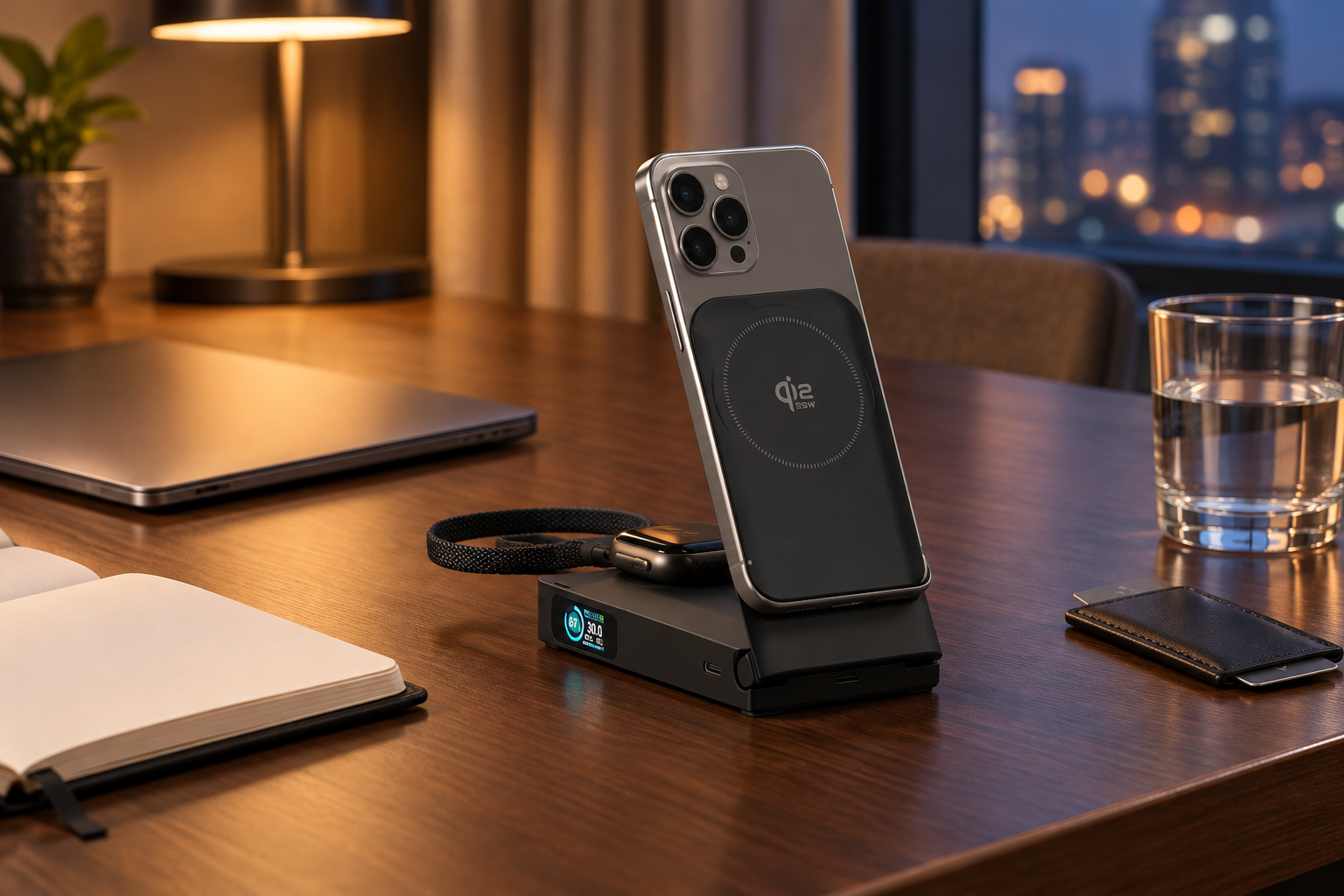
Business travel often means moving from gate to car to meeting room with little time to reset. A charger that does more than replenish a phone can reduce what you need to arrange at every stop. The FlipMag transforms into a multi-angle charging stand, giving compatible phones a practical place during desk-based moments.
That flexibility is useful when the phone needs to stay within view for notifications, timing or calls. The key benefit is not simply charging; it is keeping your essential screen accessible while your workspace remains orderly. A foldable stand is a strong fit for a hotel desk, a quiet lounge table or a temporary workstation between appointments.
For wired needs, the power bank provides 30W USB-C Power Delivery input and output through its USB-C port and integrated cable. This gives a business traveller options: use wireless charging when convenience is the priority, or use USB-C when a wired connection better suits the device and the moment. Planning for both avoids a single-method charging routine.
For vacations: protect your navigation and camera day
Holiday charging needs are less predictable than office charging. A full day may include route finding, tickets, restaurant searches, photos and messages, often far from the room where you started. In this setting, a travel charging solution needs to support the moments that matter without demanding constant attention.
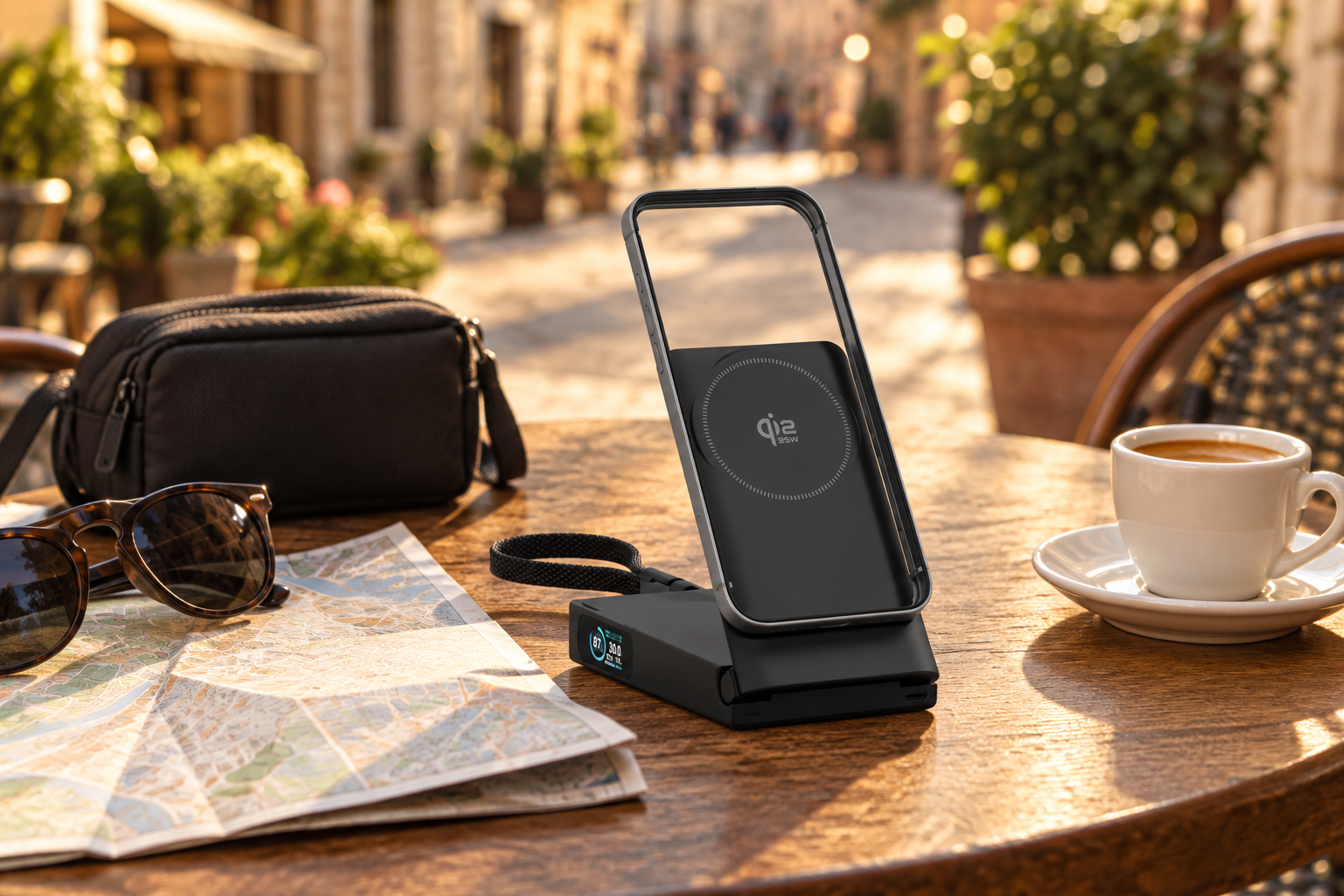
The FlipMag’s MagSafe-compatible wireless charging is convenient when you want to restore power during a break rather than create a full charging station. A café pause, museum rest area or evening wind-down can become a chance to rebuild your phone’s reserve for the next part of the itinerary.
Travelling with a smartwatch adds another planning layer. The dedicated 2.5W wireless watch module gives the FlipMag a role beyond phone power, so you can think about your personal devices as one kit. Remember that the listed simultaneous output is 15W maximum; when charging more than one device, allow extra time and prioritize the device you will need first.
Choose wireless, USB-C or both with purpose
A good travel routine does not force every situation into one charging method. Wireless charging is ideal when compatible devices and easy placement are the priority. The FlipMag supports phone wireless outputs of 5W, 7.5W, 10W and up to 15W, so it can match the compatible device’s charging capability without adding another loose lead to your bag.
USB-C is the better choice when you specifically want a wired connection. The power bank’s port and 22.5cm integrated USB-C grip cable both support up to 30W maximum input and output under their stated profiles. Keeping that cable integrated can be particularly helpful when you want to avoid discovering that your separate cable is in another pocket or suitcase.
Think of the two methods as complementary. Use the wireless side for quick, tidy phone charging at a table. Use USB-C for a connected device or for recharging the power bank itself. This approach is more flexible than buying around one headline feature, and it makes the FlipMag better suited to changing travel conditions.
Pack smarter with a clear power routine
Travel charging works best when it is planned before the battery becomes urgent. Begin with the power bank charged, then use the real-time digital display to keep track of remaining power during the day. A visible readout supports better decisions than waiting for a device to reach its last few percent.
Put the power bank somewhere easy to reach in your personal bag, rather than burying it under items you will not need until check-in. Keep its role specific: it is for on-the-move reserve power, while available wall outlets are opportunities to restore the bank through its 30W USB-C input. This preserves flexibility for the periods when outlets disappear.
It is also wise to match your charging expectations to your itinerary. A short city break may require occasional phone support, while a travel day with connections may call for deliberate battery checks at each stop. The built-in safeguards against overcharging add reassurance, but good travel habits still begin with checking power before leaving and before long stretches away from an outlet.
Know the trade-offs before you leave
No single power bank is the ideal answer for every traveller, and recognizing trade-offs leads to a better choice. If your priority is the lightest possible pocket carry for a very short outing, consider whether you truly need a 10,000mAh power reserve and a folding stand. If your day involves long gaps between outlets, those same features may be exactly what make sense.
Wireless charging offers clean convenience, while a USB-C connection gives you another route when wired charging is preferable. For multi-device moments, bear in mind the 15W maximum simultaneous output. A realistic plan—charging the most urgent device first, then the next—will feel more dependable than expecting every device to charge at its highest individual rate at once.
Material and everyday durability also matter for travel gear. The FlipMag uses ABS and polycarbonate, and its folding format is designed to move between compact storage and a stand setup. Treat it as part of your essentials kit: keep it accessible, keep it charged and use the configuration that suits the stop you are currently making.
The right MagSafe companion is the one that adapts
The most useful MagSafe power bank is not defined by one number alone. It should suit the way you move. For commuters, that may mean uncomplicated wireless support and a clear battery readout. For work travel, it may mean a folding stand plus USB-C flexibility. For vacations, it may mean keeping both phone and smartwatch plans on track.
The Powerology FlipMag brings those needs together with Qi2 15W wireless phone charging, a 2.5W watch charger, USB-C PD capability, an integrated cable and a digital display. Its value is in letting you shift from compact carry to a more organized charging point when the setting changes.
Before your next journey, map your longest likely time away from a socket and identify the device you cannot afford to lose. Then choose a charging routine around that reality. With the right preparation, portable power becomes less of an emergency fix and more of a quiet, dependable part of every trip.